
Steel from Raahe in the World’s Largest Cruise Ships
Steel produced at SSAB’s Raahe mill plays a key role in the construction of the world’s largest cruise ships. The Raahe site has a long-standing collaboration with the Meyer Turku shipyard—resulting in solutions that combine high quality, delivery reliability and efficient logistics.
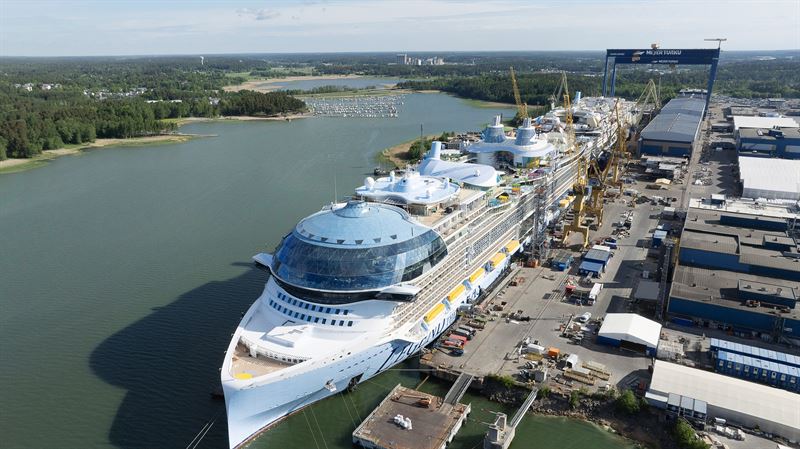
Legend of the Seas. Photos: SSAB
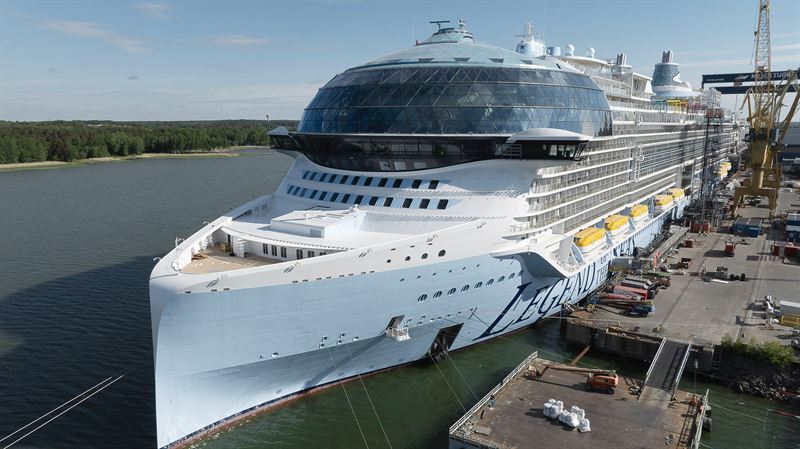
Meyer Turku is currently building massive Icon-class cruise ships for Royal Caribbean Group. The third vessel in the series, Legend of the Seas, has now been completed and will begin sailing in the Mediterranean in July. The fourth and fifth vessels in the series are currently under construction at the shipyard. In addition, Royal Caribbean Group has confirmed orders for the sixth and seventh ships, which are scheduled for delivery in summer 2029 and 2030.
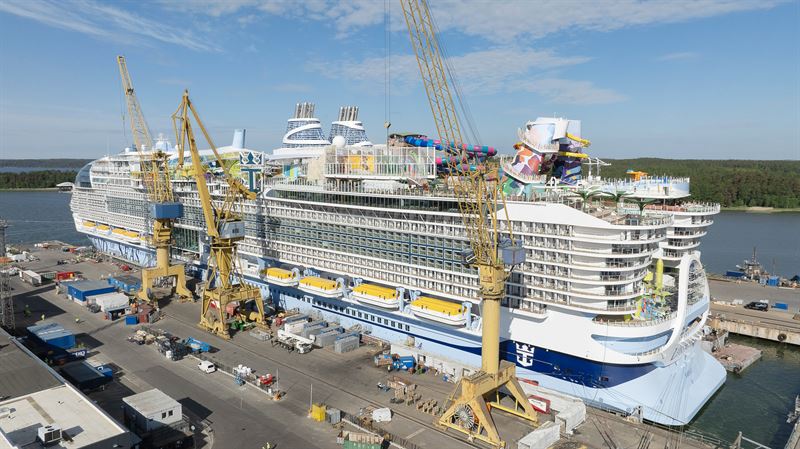
Meyer Turku specializes in the design and construction of the world’s most modern and energy-efficient cruise ships. Legend of the Seas is 365 meters long, 70 meters high and 50 meters wide, with a standard capacity of around 5,600 passengers (up to 7,600 at maximum). The vessel employs well over 2,000 crew members and features 28 restaurants, 7 swimming pools, as well as extensive entertainment, retail and service offerings.
Steel at the Core of Cruise Ship Structures
Both standard steels and high-strength shipbuilding steels are delivered from SSAB to the shipyard. The steel plates used in the hull structures of the cruise ships are supplied by SSAB’s Raahe mill. Deliveries include several strength grades of shipbuilding steel, used in applications such as hull blocks and deck structures.
Building a large cruise ship requires a significant amount of steel. Steel forms the structural backbone of the vessel. “Material properties such as strength and uniformity are critical for safety and performance,” says Ossi Kangas, Product Manager for Plate and Strip Products at SSAB Europe.
At the shipyard, the steel plates are transferred from the storage yard to further processing, including shot blasting and priming, before entering production. Plates are cut into block components that are assembled into small blocks. These are then combined into larger blocks, which are welded into mega-blocks. The mega-blocks are transferred to the dry dock, where they are joined together, gradually forming the shape of the ship.
Product Development Plays a Key Role
In Raahe, steel is produced in an integrated process in which carbon is removed from molten iron and the properties of the steel are precisely tailored for different applications. At the plate mill, steel slabs are rolled to plates and further processed in accordance with customer requirements.
Product development and quality assurance are an integral part of production: properties are continuously tested both during the process and in research laboratories. Products are also developed in close collaboration with customers to meet the demanding requirements of applications such as large cruise ships.
At the Raahe steel plant’s main laboratory, both raw materials used in steel production and final products are analyzed. The scale of the fully automated spectral laboratory is illustrated by the fact that around 240,000 samples are analyzed annually, resulting in approximately 4.4 million determinations.
Long-term Partnership Supports Demanding Shipbuilding
SSAB has a long history of cooperation with the Meyer Turku shipyard. Over the years, this collaboration has developed into a close partnership, where understanding the demanding needs of the shipbuilding industry — whether in terms of schedules, quality or technical requirements — is essential.
One of SSAB’s competitive advantages in the shipbuilding sector is its efficient supply chain. Steel plates are transported from Raahe to the Turku shipyard by rail, where they are unloaded into an automated plate storage facility. This streamlined logistics model supports delivery reliability and enables a steady flow of materials into production, which is critical in large-scale projects with tight schedules.
“In shipbuilding, everything starts with reliability. In projects of this scale, the precision of material deliveries and consistent quality are critical,” says Janne Pirttijoki, Head of Production at SSAB Europe.
“We value consistency in quality and predictability of deliveries in a partner. With SSAB, we have been able to build an efficient supply chain,” comments CEO Casimir Lindholm from Meyer Turku.
Towards Lower-Emission Shipbuilding
Shipbuilding steels represent a significant share of SSAB’s plate business: when all vessel types are included, they account for approximately one fifth.
The transformation of the steel industry towards low-carbon production is opening new opportunities in shipbuilding as well. SSAB is developing solutions that support customers’ climate targets and enable the construction of vessels with lower emissions.
“The role of low-emission steel products is also growing in shipbuilding. Together with our customers, we are seeking solutions to reduce the climate impact across the entire value chain,” Pirttijoki concludes.
FACT BOX
Meyer Turku
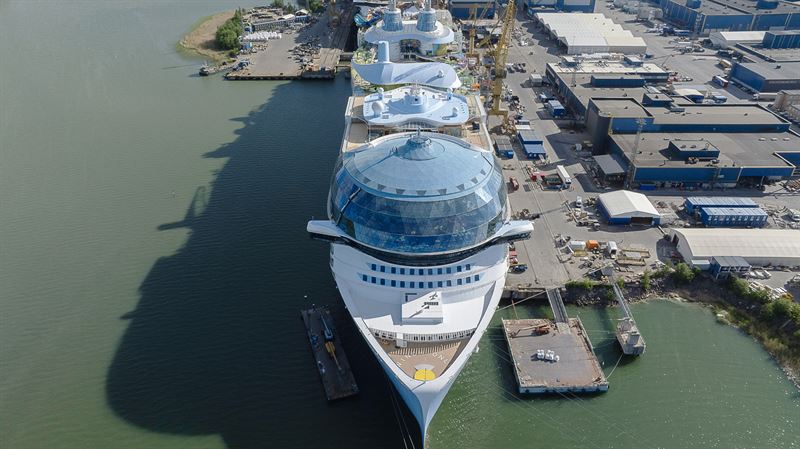
Meyer Turku Oy builds the world’s most modern and energy-efficient cruise ships, car ferries and special vessels. In 2025, the company’s revenue was EUR 2.1 billion. It employs more than 2,300 top professionals at the Turku shipyard, where ships have been built since 1737.
Legend of the Seas
https://www.meyerturku.fi/en/products-and-technology/world-class-cruise-ships/
Tags: